Good Academic Support Starts Before a Grade Emergency
Learn how academic support in a private high school should work before grades drop, from placement and tutoring to parent communication and course planning.
A grade emergency rarely begins with the grade itself. It starts earlier, usually in quieter places: half-finished homework, a test review that does not turn into recall, a student who stops asking questions, or a course choice that avoids challenge because the harder path feels unsafe.
The useful question is not whether a private high school has "extra help." It is what happens before the report card makes the problem obvious.
Good academic support keeps responsibility on the student while making the warning signs harder to miss. Teachers still expect effort. Advisors still expect follow-through. The school, however, needs a way to turn early evidence into action instead of waiting for one bad month to define the semester.
Look For The Missed Pattern
Most academic problems have a quieter draft. A student participates well in class but writes without structure. Another understands the first math step, then loses accuracy when a problem has more layers. A third keeps up for two weeks, then begins relying on reminders to finish ordinary work.
Those are not the same problem. One may be a writing issue, one may be a fluency issue, one may be an organization issue, and one may be a placement issue hiding behind decent grades.
At ConcordPrep, support is built into the student experience through small classes, advising, tutoring, structured study, progress review, and family communication. The important test is connection. A teacher observation has to reach advising. A tutoring conversation has to change the student's practice. A parent update has to name what comes next.
That is the gap between "help is available" and "the school knows what it is watching."
Placement Is The First Support Decision
Before tutoring, there is the first schedule.
A ninth grader placed too low may earn easy grades while losing the habit of productive challenge. A student placed too high may spend the opening months trying to survive instead of building confidence. Both versions can look acceptable for a short time. Neither gives the family a clean read on the student.
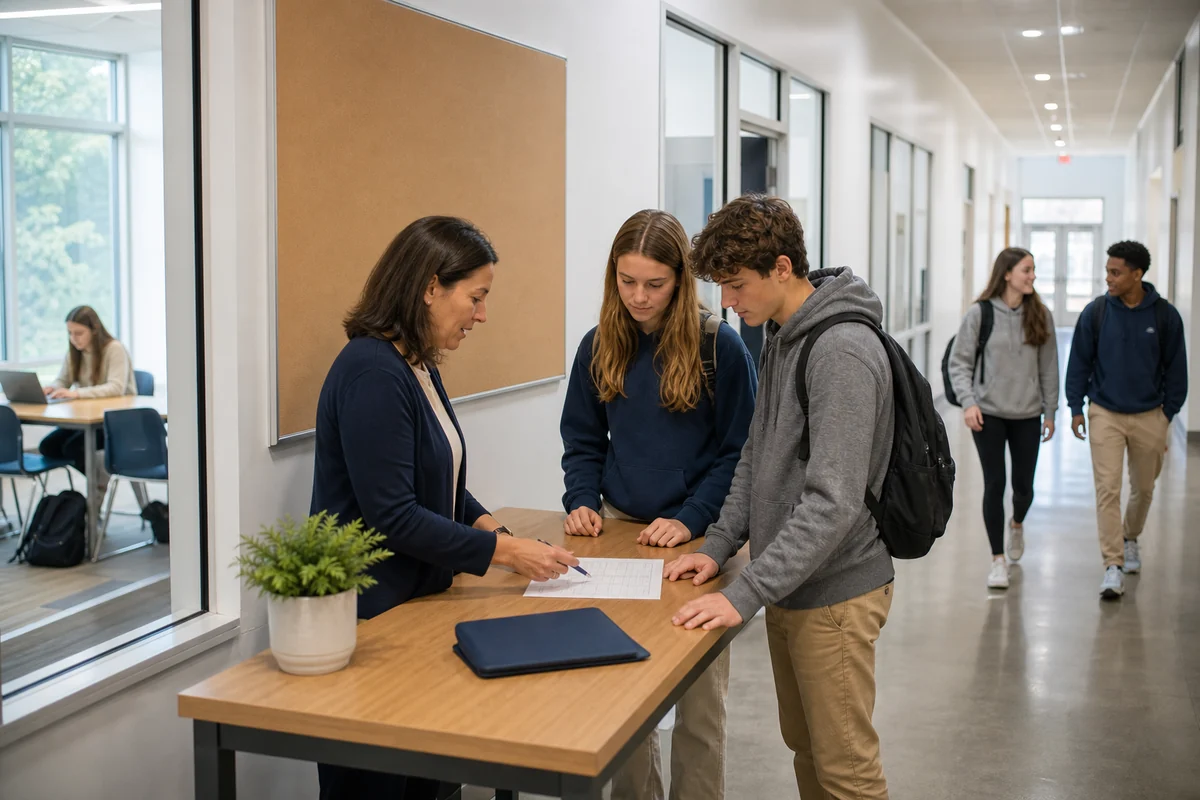
Use the placement and course sequence conversation as a support check, not only a course-shopping exercise. For ConcordPrep families, that conversation can include incoming-student placement, core progression, Pre-AP recommendations, AP options, and early intervention when performance drops below target. The practical follow-up is simple: how would those rules apply to this student?
A Tutoring Slot Is Not A Plan
Tutoring can become a vague promise when no one can say what it is meant to fix. "Extra help" is not specific enough. A student may need targeted writing feedback, math practice that revisits a missed skill, study planning before a heavy test week, or help understanding why effort is not turning into results.
The Institute of Education Sciences practice guide on organizing instruction and study to improve student learning points families toward a useful distinction: study time is not automatically effective time. Spacing learning, using quizzes to revisit content, and helping students allocate study time are different from simply asking a student to "study more."

That distinction changes the admissions conversation. A school can say tutoring is available. A more useful answer explains how the target is chosen, how teachers know whether it is working, and when the student no longer needs the same kind of help.
Parent Updates Need A Next Move
A number by itself can create more confusion than clarity. A parent who hears that a student has an 82 in a course may not know whether the problem is missing work, weak tests, careless errors, poor writing organization, late-night fatigue, or a placement issue.
The better update gives parents a next move. It explains what the school is seeing, what has already been tried, what the student is being asked to do next, and when adults will check again. That does not mean parents manage every assignment from home. It means a concern seen at school does not stay invisible at home for weeks.
The same idea appears in the IES practice guide on preventing dropout in secondary schools, which recommends monitoring student progress and proactively intervening when attendance, behavior, or academic problems first appear. A college-preparatory private school is not using that guide as a script, but the principle is relevant: waiting until a student is fully off track gives everyone fewer options.
Rigor Needs Friction, Not Panic
Some families worry that academic support means the school will lower expectations. That is the wrong tradeoff.
The stronger version of support protects rigor by helping students meet it more consistently. Capable but disorganized students may need a planning routine. Strong math students who write unevenly may need targeted writing feedback. Students excited by advanced coursework may need to learn how to recover after the first difficult grade instead of dropping challenge altogether.

Support also connects to college counseling. ConcordPrep's college counseling begins before senior year, with course selection, AP strategy, activity focus, family communication, and long-term university planning folded into the process. Needing support does not put a student outside the college-prep conversation. The support record helps show how the student handles challenge over time.
For early college or advanced pathways, the same logic applies. A harder course is valuable only if the student can learn well inside it. Support gives the school and family a more honest way to decide when challenge is productive and when the sequence needs adjustment.
Listen For Operating Verbs
When a private high school talks about academic support, verbs reveal more than nouns. "Tutoring," "advising," and "study hall" are categories. The useful answers sound more operational.
- Place new students, then revisit the placement when evidence changes.
- Notice classroom patterns before a grade drops sharply.
- Assign tutoring to a specific skill, habit, or course concern.
- Review progress on a schedule, not only after a parent asks.
- Adjust support when the problem turns out to be readiness, writing, math fluency, planning, or follow-through.
- Communicate the next check-in so the student knows the plan is being watched.
None of those verbs guarantees a smooth semester. They do make the system visible. A family does not need a perfect promise. It needs evidence that adults can name the next step when the student's week starts to wobble.
The Ten-School-Day Test
Imagine the first ten school days after enrollment. The student is learning the schedule, meeting teachers, taking the first quizzes, figuring out homework rhythm, and deciding how much help feels safe to ask for.
Now add one complication: two missed assignments in English, a weaker-than-expected math quiz, or a student who says everything is fine but grows quieter each evening. The academic support question becomes concrete. Who sees the change? What information gets shared? Is the response tied to the course, the habit, or the student's confidence? When does the family hear something useful?
Academic support also belongs in the cost conversation. The earlier guide on what tuition alone does not show looks at hidden costs from the family-budget side. This article looks at the student side: outside tutoring, repeated course recovery, late intervention, and transfer disruption can all become expensive when support inside the school is thin.
For a ConcordPrep conversation, bring the student's transcript pattern, strongest subjects, weaker subjects, homework habits, writing confidence, math history, activity load, and any previous support that has or has not worked. Then ask how the first semester would be built around that real student.
The answer does not need to guarantee a perfect year. It needs to show how the school notices, responds, adjusts, and communicates before a grade emergency becomes the only thing anyone can see.